This month's Keys to Life interview focuses on the new exhibition by Yinka Ilori. Noah Markson had the opportunity to speak with Yinka about his exhibition and the message conveyed through his art. Yinka has become one of the UK's most celebrated multi-disciplinary artists. Renowned for blending his British-Nigerian heritage into vibrant contemporary art, his major achievements include receiving an MBE for services to design, winning the London Design Festival's Emerging Design Medal, and co-designing the iconic 2021 BRIT Awards trophies and stage.
How would you describe the overall feeling of the exhibition, and can you tell us the story behind what inspired it?
The inspiration essentially comes from looking at my family’s past and their move from Nigeria to London. The exhibition highlights and celebrates those moments of resilience, and the experiences of people who made that journey, carving out spaces for joy. I’m looking at it not just from a micro perspective, but also through the rituals and experiences that they had in between. Things like going to church every Sunday, dancing, listening to music, and just being really joyful. Those were ways of responding to adversity and building resilience. I also looked at how people facilitated gatherings parties, not only in community halls but in homes with friends and family. If everyone was wearing the same lace, the same textiles and the same prints, it became a way of celebrating where they came from. My parents, like many immigrants, were dealing with a lot. They were trying to establish themselves here while also carrying the responsibility of supporting family back in Nigeria. There was the stress of being separated from loved ones, working hard, sending money home, and often trying to build a house back there at the same time. All these things they were dealing with made them really resilient. And I think one thing that always strikes me is that the resilience they had to demonstrate was very different from what younger generations experience today. Different challenges, different times. But I wanted to highlight those specific moments and the joy that existed around them
Is there any particular significance behind the flowers, the motifs and the lace?
Yeah, absolutely. For me, the yellow trumpet floweris important because it’s Nigeria’s national flower. It represents prosperity and renewal. Then there’s the daffodil. For me, it’s a flower that really signifies hope and the feeling of spring coming. You see it appearing in weird places and you think, ‘How is that blossoming?’ Someone planted those seeds by hand. Looking at both my British and Nigerian heritage, I was interested in the similarities between those two flowers. Those two flowers embody a lot of things for me. Everyone talks about the British rose, but if there was another flower that symbolised Britain for me, it would be the daffodil. Together, those flowers represent resilience and hope. They also connect to the colour yellow, which appears throughout the exhibition. My parents wore a lot of yellow and pink, and those colours often appeared in the textiles and lace they wore.
I have a huge archive family photographs, especially of my dad wearing these incredible textiles. The fabrics were covered in embellishments patchwork flowers, diamantés and embroidery – and they were really expressive.
Your use of colour is always so striking. How do you go about choosing the right shades and colour combinations?
It’s definitely something I’ve absorbed over a lifetime. A lot of it comes from my archive of family photography and images. We have what we call a colour bible in the studio that we refer back to across projects. But honestly, I’ve just been around these colours my whole life. I know the right tone of yellow, the right purple, the right red, the right pink. If something doesn’t feel right, we go back to it until we get it right! My mother in particular was very meticulous in her choice of colour. She cared deeply about finding exactly the right shade. She loved purple, for example. So, I don’t think it’s something you can study for; it’s
something that’s ingrained in you. It’s just become instinctive.
On a musical note, what are you listening to at the moment? Are there any artists or sounds inspiring you right now?
At the moment I’m listening to a lot of Sub-Saharan music. Music from Ivory Coast, Senegal, Nigeria and beyond. One artist I love is Sona Jobarteh. She’s incredible. I saw her perform at the Roundhouse a couple of years ago. She’s a musician who plays the
kora, and she’s phenomenal. What was amazing was seeing multiple generations of her family performing together. Her son played the xylophone, and I’d never heard anyone play it so beautifully. It completely changed the way I thought about the instrument. There’s a song of hers called Gambia that I absolutely love. Whenever I hear it, it takes me back to Africa. For me, it carries themes of hope, resilience and joy. I’m also inspired by my good friend and collaborator Peter Adjaye, who is one of the artists commissioned for this project, and by the musician, artist and producer James William Blades. Both have
contributed pieces to the exhibition. And over the weekend I’ve been listening to a lot of Frank Ocean His songwriting, his lyricism and the way he tells stories are incredible.
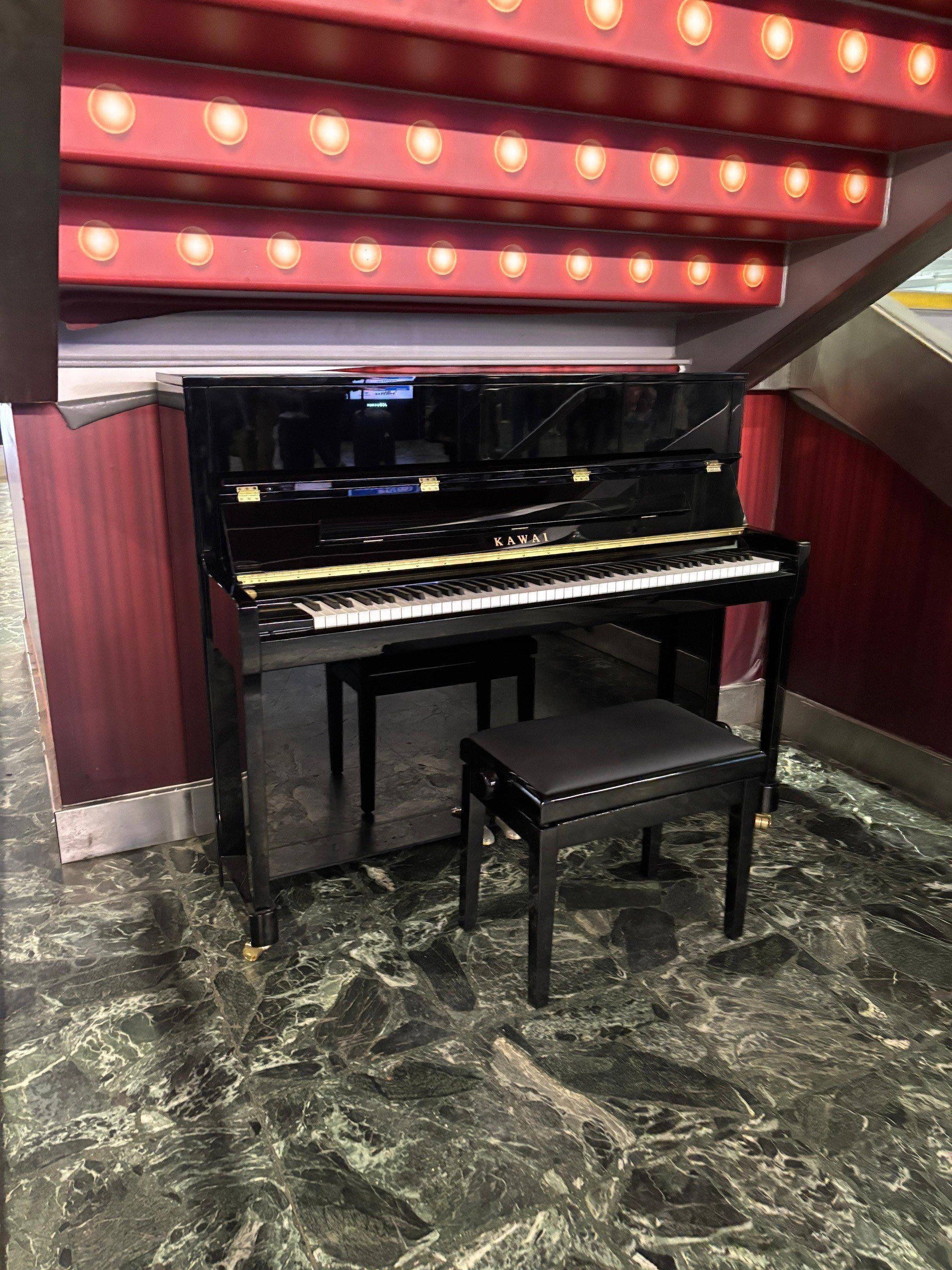
For this exhibition, Markson Pianos has supplied two pianos, adding another sensory layer to the space. How does bringing together your visual language and music influence the way audiences experience the work?
Firstly, thank you, Noah, for being part of the show. We have our own connection and history, and it’s exciting to see how it has all come together. The piano plays a huge part in praise and worship. There is no choir, no church music, without the piano and pianist. Because of that, it felt like an essential part of the installation. The piano extends the visual language of the exhibition. The joy that music brings is almost imprinted onto the shell and the body of the piano. For me, it feels as though the piano is singing, even when nobody is playing it. It’s taking my language of this idea around resilience and hope. It also connects to my experience of growing up within a Pentecostal church community and bringing that atmosphere into a public space. I want people to understand the power of music, not just as something we listen to, but as something that shapes our lives.
How does music correspond with the message of your exhibition?
Music has always been tied to resilience. If we look back through history, including during slavery, music became a form of communication, resistance and survival. It was a way of responding to oppression, pain and suffering. For me, the music integration in the exhibition is a reminder not to underestimate the power of music in our lives and what it can give to people.
Looking back at your early creative journey, what do you wish someone had told you when you were starting out? What advice would you give to young creatives trying to find their own voice?
For me, it’s all about consistency. Consistency in your voice, your story and your design language. If you look at my work from ten years ago, you’ll still see the same themes of folklore and storytelling. That’s something I’ve been pushing for. Just because something isn’t immediately working doesn’t mean it’s wrong. If I wasn’t consistent in representing the folklore and storytelling with my chairs, because it wasn’t being picked up by major publications at the time, there’s a good chance I wouldn’t be where I am today. As long as you have the right people around you and you genuinely believe in what you’re putting out into the world, that’s what matters. Consistency is the key.
The exhibition at Cristea Roberts Gallery, titled Joy Through Resistance: He Who Laughs Last, Laughs Best, showcases Yinka’s natural talent and message of resilience. Read our interview via the links below; if you get the opportunity to visit, the exhibition is open until 11 July.
Yinka Ilori | Joy Through Resistance: He Who Laughs Last, Laughs Best | Cristea Roberts Gallery
RELATED ARTICLES